7 Bathroom Hooks Buying Tips for Global Buyers
Buying Bathroom Hooks for international projects is rarely a simple styling decision. A hook must survive humidity, daily pulling, cleaning chemicals, and uneven installation surfaces. It also needs dependable packaging and consistent dimensions across large shipments.
The wider bathroom accessories market reflects strong demand. Grand View Research estimated its global value at approximately USD 22.8 billion in 2023. The report also projects continued growth through 2030, supported by renovations and improved residential construction. Bathroom hooks represent only one category, however. That distinction matters. A large market figure does not guarantee reliable hook suppliers.
Moisture changes everything. Cleaning expert Mary Gagliardi, known as “Dr. Laundry” and a former Clorox scientist, states, “Moisture is the key ingredient for mold growth.” Buyers should therefore examine rust resistance, drainage around mounting points, and surface-cleaning instructions. Stainless steel, zinc alloy, and coated plastics can perform differently in a steamy bathroom. Test samples first.
This guide explains seven practical buying tips for global buyers. It covers load capacity, mounting systems, material grades, finish durability, packaging, compliance documentation, and supplier consistency. Houzz’s bathroom renovation research also shows that homeowners increasingly invest in upgraded fixtures and storage details. Yet the smallest accessory can still create complaints. A loose adhesive pad, sharp edge, or mismatched finish becomes visible quickly.
Some assumptions need challenging. “Waterproof” is not always a technical specification. Nor does a polished appearance prove long-term durability. Compare laboratory claims with real-use samples, installation photos, and written warranties. Your best purchase may look less fashionable, but perform better after repeated wet hands and daily use.
Define Your Bathroom Hook Needs and Installation Location
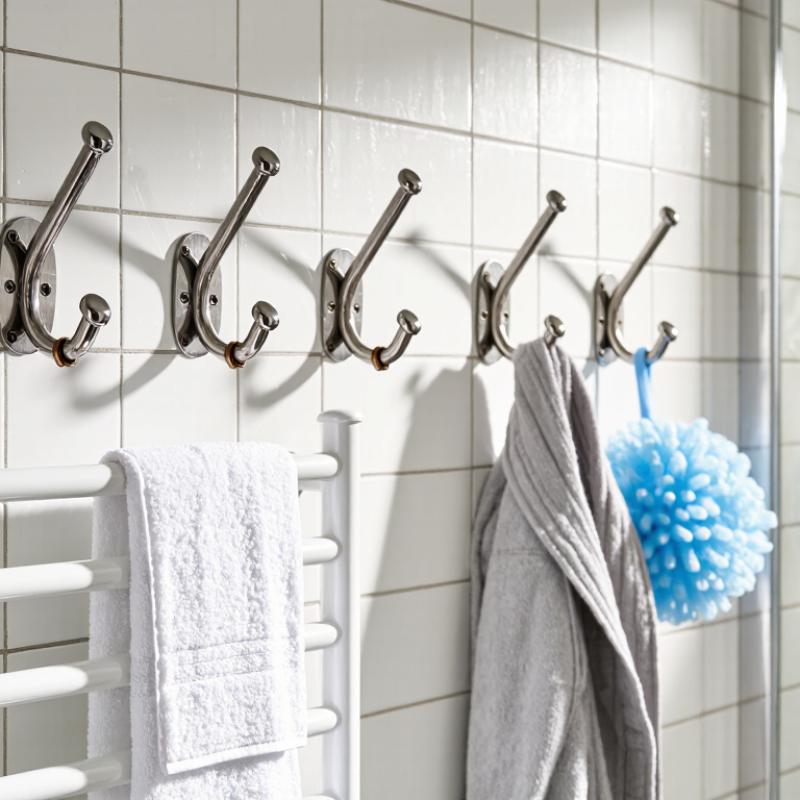
For global buyers, define the hook before choosing its finish. List the object, weight, number of users, and cleaning routine. A robe needs more clearance than a hand towel. A child’s hook needs a lower, reachable position. Wet towels need airflow, not a tight row behind the door. The 2024 National Kitchen & Bath Association Bathroom Design Trends Report highlights storage, wellness, and accessibility as continuing bathroom priorities. That direction matters. A hook is small, but its location affects daily movement.
Map the wall before ordering. Mark the door swing, vanity edge, shower screen, toilet, and electrical fittings. Keep hooks away from direct spray when possible. On tiled walls, confirm the substrate behind the tile. Adhesive alone can fail on dusty grout or textured surfaces. For heavier robes, use mechanical fixings suited to the wall type. Do not treat a decorative hook as a grab bar. The U.S. Access Board’s ADA Standards specify grab-bar heights of 33 to 36 inches and structural support requirements. Those figures guide accessibility thinking, but a towel hook is not a safety device. Placement may need local code review.
WHO reports that falls cause about 684,000 deaths worldwide each year, with adults over 60 facing the greatest risk (Falls, Fact Sheet, 2021). The statistic is not bathroom-specific, yet it supports safer circulation. A clear path beats a perfect-looking wall. Measure twice. Install once. I still see plans that ignore wet hands, wheelchair turning space, or a door opened quickly. That is worth reconsidering. For export projects, request wall drawings, fixing instructions, corrosion testing, and load data before approving the hook location. A small sample installation can reveal more than a polished catalog image.
7 Bathroom Hooks Buying Tips for Global Buyers
Define Your Bathroom Hook Needs and Installation Location
The chart shows typical market-rated load ranges for common bathroom hook installation methods. Actual capacity depends on wall condition, surface preparation, humidity, fastening quality, and the product specification. Always confirm the stated load rating before purchase.
- Identify the items the hook must hold, such as towels, robes, or small accessories.
- Measure the available wall, door, cabinet, or shower area before choosing the hook size.
- Match the installation method with the surface, including tile, glass, drywall, wood, or metal.
- Choose moisture-resistant materials for locations exposed to steam and direct water.
- Check the rated load and leave a safety margin for wet towels and repeated use.
- Consider spacing to prevent towels from touching the floor, toilet, or other fixtures.
- Confirm whether the hook can be removed, repositioned, or permanently fastened.
Compare Hook Materials, Finishes, and Resistance to Moisture
Bathroom hooks face warm steam, splashes, soap residue, and repeated hand contact. Material choice matters more than appearance alone. Stainless steel, especially 304 grade, offers strong corrosion resistance for ordinary bathrooms. Grade 316 performs better near coastal air, but it usually costs more. Brass resists moisture well, while zinc alloy needs a reliable protective coating. Plastic avoids rust, yet cheap polymers may crack under load or discolor over time.
Finish quality deserves close inspection. PVD and powder coatings can improve surface durability, but scratches may expose weaker metal underneath. Chrome plating looks bright, but damaged plating can allow corrosion to spread. The U.S. Environmental Protection Agency recommends indoor relative humidity between 30% and 50%, with levels below 60% to reduce moisture problems. A poorly ventilated bathroom can exceed that range quickly. Think of the hook near the shower, not only inside the showroom.
For global purchasing, request salt-spray evidence using ASTM B117 or ISO 9227 methods. These tests help compare finishes, but they do not perfectly predict daily bathroom performance. Ask for coating thickness, substrate details, load testing, and cleaning-cycle results. Check hidden edges, screw holes, and mounting plates carefully. They often fail first. A polished sample can still conceal weak protection. I would also question vague claims like “rustproof.” They sound reassuring, but measurable resistance data is more useful.
Verify Supplier Quality, Customization Options, and Global Shipping Terms
Global buyers should treat a bathroom hook as functional hardware, not a simple accessory. Ask for material details, coating thickness, load testing, and corrosion results. A reliable supplier should provide dated inspection records and clear production photos. Request samples from the same line used for mass orders. Test them on tile, painted walls, and damp surfaces. Check for loose adhesive, sharp edges, and uneven plating. Small faults become expensive returns.
Customization requires more than adding a logo. Confirm dimensions, colors, mounting methods, packaging, and carton markings in a written specification. Ask who approves artwork and how changes are recorded. A capable supplier should explain tooling costs, minimum quantities, sample approval, and production tolerances. I once focused too heavily on appearance. The hook looked excellent, but its adhesive failed after repeated humidity exposure. That mistake changed my inspection checklist.
Shipping terms must be transparent before payment. Compare EXW, FOB, CIF, and DDP carefully, because responsibilities differ. Confirm the named delivery point, insurance coverage, export documents, customs duties, and estimated transit time. Ask for carton dimensions and gross weight before calculating freight. Request a pre-shipment inspection, serial photos, and a packing list. Keep a buffer for port delays. Schedules slip. A supplier that answers quickly but avoids written details deserves closer review. Sometimes, a slightly higher unit price buys stronger packaging, better records, and fewer disputes.